
In the mid-90s, architect Mick Pearce faced a challenge: build a large office complex in Harare, Zimbabwe, without air conditioning. The solution came from an unlikely source: termites.
Termite mounds maintain a constant internal temperature of 31°C, even when outside temperatures swing from 1°C to 40°C. They achieve this through a complex system of convection currents—warm air rises and exits through vents, pulling cool air in at the base.
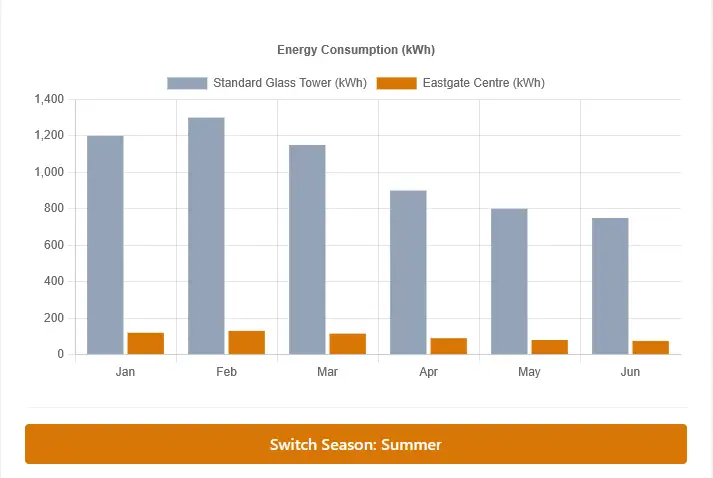
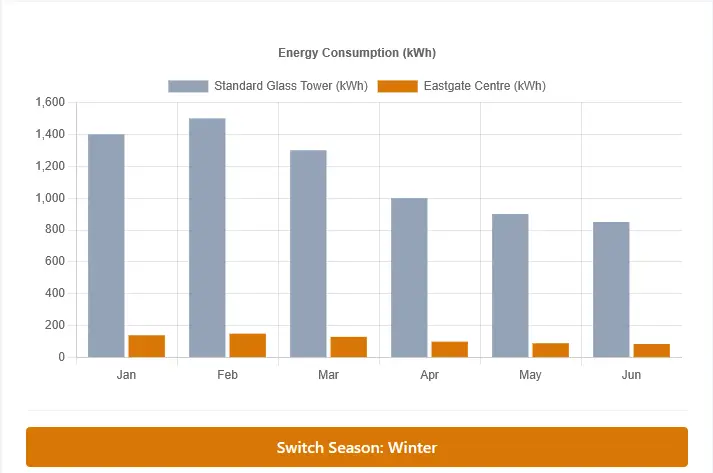
Pearce applied this to the Eastgate Centre. The building uses concrete mass to absorb heat during the day and fans to push it out at night. The result? A building that uses 10% of the energy of a conventional building of its size.
The graphs below compare the energy consumption of a standard glass tower versus the Eastgate Centre across different seasons.